ETFs vs. Mutual Funds: Key Differences Explained
ETFs vs. mutual funds compared: how each is priced, traded, taxed and disclosed, what they cost, and how to decide which structure fits, with a worked example and FAQ.
ETFs and mutual funds both pool investor money into a diversified portfolio run under the same federal law, but they differ in how shares are bought and sold. A mutual fund sells and redeems shares directly with the fund company at a price set once a day, while an exchange-traded fund (ETF) lists its shares on an exchange, where they trade all day at market prices. That difference in plumbing drives most of the practical contrasts in cost, tax treatment, minimums, transparency and trading flexibility discussed below. Neither structure is better in every case. The right choice depends on what the fund holds, how you invest and the account you use.
In brief
- Mutual funds transact at net asset value (NAV) calculated once per trading day. ETFs trade at changing market prices during the day.
- Both are generally regulated under the Investment Company Act of 1940, and both file prospectuses with the SEC.
- ETFs often have lower stated expense ratios for index strategies, but the total cost includes trading costs.
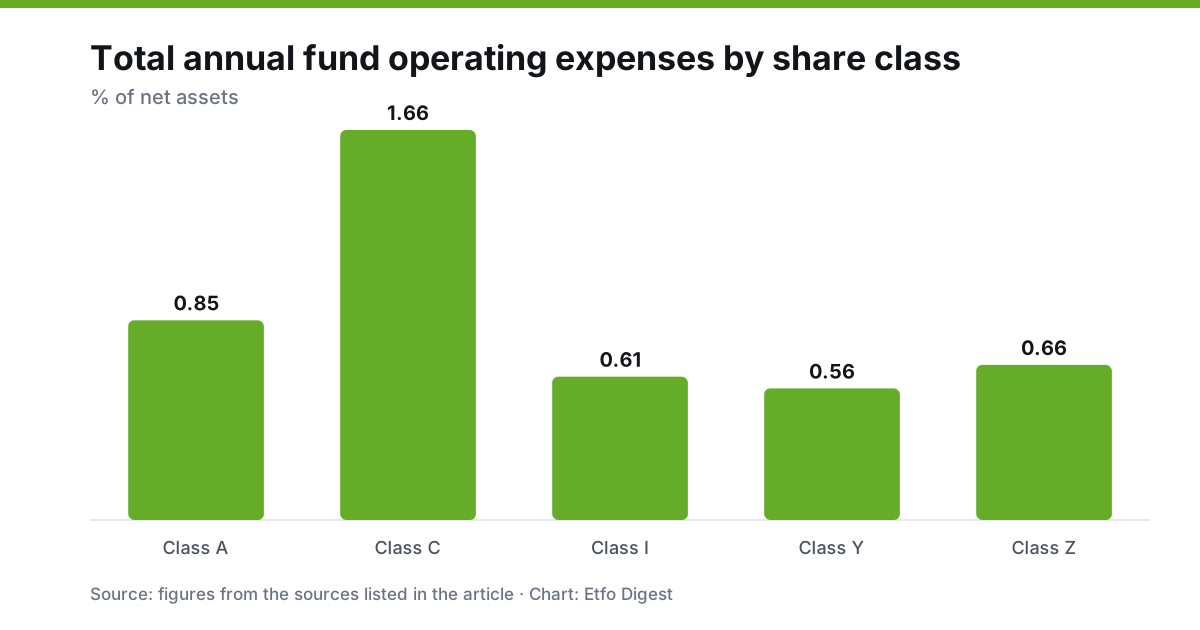
- ETF share classes of the same fund are not the same as mutual fund share classes, which can carry sales loads and distribution fees.
- Tax efficiency often favors ETFs in taxable accounts, though it varies by fund.
What they share
Most ETFs and mutual funds in the United States are registered investment companies. Both hold a portfolio managed according to a stated objective, both have a board that oversees the fund, and both must provide a prospectus describing objectives, risks, fees and performance. Both can be passively managed to track an index or actively managed by portfolio managers. Both pass through income and capital gains to shareholders, who owe tax on those distributions in taxable accounts.
Investor protections that come from this shared framework include requirements for custody of assets, limits on leverage and affiliated transactions for most funds, and regular disclosure of holdings. You can find a fund’s prospectus, statement of additional information and shareholder reports on SEC EDGAR.
Pricing: one price a day versus continuous prices
When you buy or sell a conventional mutual fund, the order is executed at the fund’s next calculated NAV. Under SEC Rule 22c-1, this forward pricing means that orders received before the pricing time (commonly the close of the New York Stock Exchange) get that day’s NAV, and later orders get the next day’s. You do not know the exact price when you place the order.
ETF shares trade on an exchange at market prices that move continuously. You can see the price, place a limit order, and know roughly what you will pay or receive. The market price may differ slightly from the NAV, creating a premium or discount, but the creation and redemption mechanism generally keeps the gap small. See our separate guide for how that mechanism operates.
How you buy and sell
Mutual funds are purchased through the fund company, a broker or a retirement plan. Many have a minimum initial investment, though minimums vary and some funds waive them for automatic investment plans or retirement accounts. You can usually invest exact dollar amounts, including fractional shares, which makes automatic monthly contributions simple.
ETFs are bought and sold through a brokerage account, like stocks. There is typically no fund-level minimum other than the price of one share, although many brokers now offer fractional shares. You can use limit orders, stop orders and, subject to your broker’s rules, margin or short selling. That flexibility is useful for active traders, while buy-and-hold investors may not need it. The ability to trade at any moment can also encourage overtrading.
Costs
Costs differ in several places.
- Expense ratio. Both types charge an annual percentage of assets. Index ETFs and index mutual funds from large providers are often very close in expense ratio. Actively managed funds cost more in both structures.
- Sales loads and distribution fees. Some mutual fund share classes charge a front-end or back-end sales load, or ongoing 12b-1 fees. Standard ETFs do not charge loads, although a broker may charge a commission.
- Trading costs. ETF investors pay the bid-ask spread and any commission each time they trade. Mutual fund investors generally do not pay a spread, but some funds charge redemption fees or short-term trading fees.
- Hidden costs inside the fund. Both types incur trading costs when the manager buys and sells securities. These costs are not in the expense ratio but affect returns.
FINRA’s Fund Analyzer and the SEC’s Investor.gov explain how to compare costs across share classes. The prospectus fee table is the authoritative source for a specific fund.
Taxes
Taxable investors care about capital gains distributions. In a mutual fund, when other shareholders redeem and the manager sells securities to raise cash, realized gains are passed to all remaining shareholders, including those who did not sell. ETFs often avoid some of this because large redemptions are commonly settled by delivering securities in kind rather than selling them for cash, which can help the fund avoid realizing gains. As a result, many ETFs, particularly index ETFs, have historically distributed little in capital gains.
This is a tendency, not a rule. Some ETFs, such as certain bond funds, actively managed funds and funds that must trade for cash, do distribute gains. Mutual funds that are index-based can also be tax-efficient. In a tax-deferred account such as an IRA or 401(k), the difference mostly does not matter, because distributions are not taxed currently. Check IRS guidance or consult a qualified tax professional for your situation.
Transparency
Traditional ETFs disclose their holdings daily. Mutual funds generally disclose holdings periodically, with a lag, through shareholder reports and regulatory filings. Daily disclosure helps investors see what they own, and it allows market makers to price the shares efficiently. Some actively managed ETFs use structures that limit daily disclosure, and the prospectus describes the policy. The SEC’s ETF rule, Rule 6c-11, sets conditions for most ETFs, including requirements for publishing portfolio holdings information on the fund’s website each business day.
Retirement plans and automatic investing
Most employer retirement plans, such as 401(k)s, offer mutual funds rather than ETFs, because plan recordkeeping systems are built around once-a-day pricing and exact dollar contributions. Some plans and brokerage windows do offer ETFs. If you save through a payroll deduction into a plan menu, your options are limited to what the plan provides. In an IRA or taxable brokerage account, both structures are usually available.
Which is better?
There is no universal answer. Features that may favor ETFs include intraday trading, lower costs in some index strategies, daily holdings disclosure and potential tax efficiency in taxable accounts. Features that may favor mutual funds include simple automatic investments, exact-dollar purchases, no bid-ask spread and availability in workplace plans. For some strategies, such as certain actively managed or niche funds, the mutual fund may be the only version available, or the best one.
A practical approach is to compare the specific funds: their expense ratios, holdings, tracking record, trading volume and spreads, and tax history. Two funds with the same name from the same sponsor may differ in structure and share class, which affects cost.
A worked example
An investor has $10,000 to put into a broad stock index strategy, which is offered as both an index mutual fund and an ETF by the same fictional sponsor, Summit Funds.
- The mutual fund has a minimum investment of $3,000, an expense ratio of 0.10%, and no load. The investor can buy $10,000 at the next NAV, and set up $500 monthly purchases.
- The ETF has an expense ratio of 0.08%, and the investor pays a bid-ask spread that amounts to a few cents per share and no commission at their broker.
On the surface the ETF is slightly cheaper. But if the investor makes twelve small monthly purchases and each incurs a spread, those costs add up. If the investor holds it in a taxable account for many years, the ETF’s tax efficiency may offset that. If the money is in a 401(k) that only offers the mutual fund, the question is moot. The point is that the answer comes from the details, not from the label. The percentages in this example are illustrative and not from any real fund.
Common misconceptions
- ETFs are not always cheaper than mutual funds. Total cost includes spreads and commissions.
- ETFs are not automatically more tax efficient. Structure and strategy matter.
- Mutual funds are not outdated. They remain the default in many retirement plans.
- An ETF’s daily liquidity does not make the assets it holds safe from losses.
FAQ
Are ETFs riskier than mutual funds?
The structure itself does not decide risk. Risk comes from what the fund holds and how it is managed. An ETF and a mutual fund holding the same stocks share the same market risk.
Can I convert a mutual fund into an ETF?
Some sponsors have converted mutual funds to ETF share classes or merged them into ETFs, and the SEC has permitted certain structures. Those transactions can have tax consequences, so read the sponsor’s notices.
Why does my retirement plan only offer mutual funds?
Plan administration systems commonly rely on once-a-day pricing and exact-dollar contributions, which suit mutual funds. Ask your plan administrator whether a brokerage window is available.
Do ETFs have minimum investments?
Typically only the price of one share, or less if your broker offers fractional shares. Mutual funds often set minimums, though they vary.
Where do I compare fees for specific funds?
The prospectus fee table is the primary source. FINRA’s Fund Analyzer and Investor.gov provide free tools and explanations.
Prepared with AI assistance from public sources and reviewed under our editorial policy. Not investment advice.